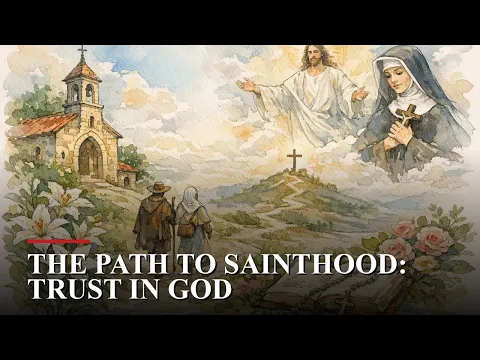
The Path to Sainthood: Trust in God
Summary of Headings
- The Call to Sainthood
- Examples of Saintly Trust
- The Power of God's Grace
- Our Unique Vocation
- Knowing God Through Faith and Prayer
- The Silence of Trust
The Call to Sainthood
Such a glorious feast that we have today. We're getting spoiled. Last week we had All Saints Day. Or as a King today, we have All Saints Day. One of the most beautiful feasts because it reminds us of the very simple fact of why we are here. We are here to become saints. And more than that, it's not an impossibility. Many times when we contemplate what is needed to become a saint, it just seems so daunting. We have to have integrity. We have to be in control of ourselves. We have to grow in virtue. We have to have a good life. We have to have heroic virtue to be a saint.
We have to be a paragon of virtue. We have to follow the will of God in all things. So much so that it calls attention to everybody who comes into contact with us, so that Vatican can look at us and say, that person practiced this virtue heroically. We have to be faithful to all things in God. But the fact of the matter is, out of this poor clay, it doesn't seem like saint. It doesn't seem like such a glorious thing can come about. We are not the stuff of which saints are made, to paraphrase St. Thomas More. And yet, God makes saints of us. Because it isn't the material that matters, it's the workman, the one who actually puts everything together.
Examples of Saintly Trust
And that is Christ. One of the most important attributes of the saints, universally, is their absolute confidence and dependence on God. St. Thomas More. However, he even perduces Christ. This is not—the Android somewhat has a different giganticajaciente. She was going to accomplish this because God had commanded it, because this was the will of God. Therefore, she knew it was going to happen, no matter what, if she just continued to work at it. And sure enough, the Carmelite order, the Scalced Carmelites, precisely have their rule because of her, have their extraordinary life because of her and her labors.
She renewed them absolutely. We have many examples of the saints going through that. St. Augustine, fighting against the grace of God for so long, desiring even to become a saint, but not yet. Again, paraphrasing. It's not exactly what he said. But trying to become a saint without actually making the final steps to become a saint. Trying to get close to God, but without actually making the final big move into uniting himself. To uniting himself to the will of God. To accepting sanctity, to accepting the sacrifice that sanctity would demand of him.
The Power of God's Grace
But the lesson that he learned, because he didn't believe he could actually be a saint, the thing that held him back was the fact that he didn't actually believe that he could be holy. He had been such a sinner his entire life, he didn't believe that he could actually be holy. And somehow it was revealed to him that that is not the case. That it's Christ who sanctifies. And if other people can be sanctified by the grace of Christ, why not him too? We look at the image of the good thief. One simple act of a man whose life had been theft and murder. One simple act of faith, and he gets promised the kingdom of heaven.
That confidence that this crucified man by his side, this man who was reviled and hated and was being mocked and jeered, this man who had absolutely no faith, no power according to human reason and human judgment, and yet that single act of faith gave him heaven. Because he absolutely believed in the power of Christ. For us, this is where the inspiration for our sanctity must lie. We are not the saints. God makes us the saints. We are not the heroes of the church. God gives us the power. And the vocation to fight for the church. He's the one who saves it. He's the one who takes care of it.
We cannot save the souls of our children. God gives us the power and everything that we need to be the instruments that he can save them. God is the one in charge. This is more relevant now than ever before in history. Where we see nothing but darkness all around us. Where we see the obscurity of what's going on. Where we see the darkness of what's going on. Where the world has such dominion over the souls of each and every one of us. Where comfort and technology and everything else that goes along with it have a firm hold on our souls. It seems insurmountable.
It seems like the darkness is one. Bad habits that go back years. Decades. A lifetime. A lack of grace. Because of a life misspent. Or confused or lost. But God's grace is all powerful. And he can save each and every one of us. And he will. If we entrust ourselves to him. If we let him do the work that is necessary to our souls. We can read the lives of the saints.
Our Unique Vocation
And we're supposed to marvel at them. We're supposed to find them extraordinary which they are. We're supposed to love them. And we're supposed to follow in their footsteps. But we are not meant to emulate them. We are not supposed to do exactly what they did. Not a one of us can be a Saint Teresa. She was given a very specific mission and a very specific time for a very specific order. And her sanctity was dependent and contingent upon that. Her fidelity to that calling and the grace that God gave her for the success of that calling. Those of us, each and every one of us, we have our own vocation.
We have our own calling. And it is for us to also entrust ourselves as absolutely as Saint Teresa did. For the purpose of being able to serve God faithfully in all things. We belong to God. Our life is His. The saints understood this. The work that we do belongs to God. As parents, as children, as students, as laborers. Whatever our life is. It belongs to God and the only way to sanctify it is by following God. Following the calling of God. And trusting in Him absolutely. Again, this is even harder because as much as the world is dark and as bad as the world is.
And as much as it has much power over us. And tries to influence us and rip us away from God. As terrible as that is. Even worse. The church, which is supposed to be the paragon that is supposed to be the guiding light. Is not doing its job. It's more worried about the world than it is about God. It's more worried about the world than it is about your souls. So it makes it even worse. It's compounded the problem a hundredfold. So many souls lost because of this. Not understanding their relationship that they're supposed to have with our Lord Jesus Christ. And not being able to trust Him entirely.
Because if the church is more worried about the practical and the worldly. Then how are they going to, how are we going to be able to find the divine.
Knowing God Through Faith and Prayer
And trust everything to our Lord Jesus Christ. The answer is very simple. We just have to learn to do it on our own. We have to do it by knowing who God is. The reason that the saints trusted God so absolutely. The reason that they believed and trusted everything in Him. Was for the very simple reason that they knew who He is. They knew who He is and they trusted Him because He is who He is. In the act of faith we declare that we accept all the doctrine of the church. Because God Himself has taught it to us. Who can neither deceive nor be deceived. Those words are so powerful when we think about it.
God cannot be deceived. God cannot deceive. Why? Because He is truth itself. God cannot demand anything evil of us. He cannot encourage evil or He cannot give evil. Why? Because He is goodness itself. He cannot lead us down the wrong path. He cannot betray us. He cannot deny us. Why? Because He is goodness and truth and love itself. But unfortunately we humanize Him so much. That all we can see in Him is like with every human. A potential traitor. A potential liar. Because He is human in our minds. And that's where we're wrong. That's why we don't actually know Him. And that's why we can't trust Him as we're supposed to.
We can't let go. We can't let go of control of our lives. Why? Because we don't trust God. Why don't we trust God? Because we don't see Him as God. We don't understand who He is as God. Why don't we know that? Because we're not praying like we should. Because we don't know the faith like we should. Those two things are essential for the making of a saint. We have to know the faith in order to live it. We have to know the faith to know who God is. We have to know who God is by actually learning about Him. This is why the Catechism is so important. It is so crucial for everybody, not just for children.
And the tendency is that we get the children through confirmation and then that's it. But each and every one of us should study the Catechism regularly. We should read the Bible regularly. We should read commentaries of the Bible regularly. There should be daily spiritual reading and daily scriptural reading or doctrinal reading. Each and every one of us. The second thing is prayer. It's good to know God on a doctrinal and theological level. But we also have to know Him on a deeply personal and intimate level. And that is where prayer comes in. We are called upon to know, love, and serve God.
How can we love Him and serve Him if we do not know Him? We know Him because we know more or less what the Catechism and St. Thomas Aquinas and others say about Him. But we have to know Him. How He affects us personally. Who He is to us. Why He loves us so much. We can learn about His crucifixion and death. We can learn about the doctrinal reasons why He did this. But we don't understand or appreciate the fact that what His love for us looks like. What that crucifixion means for us. Until we actually pray and listen to the words of His love in our very souls.
And one of the reasons is that we have to know Him. And one of the reasons that we cannot do that is because we let too much noise into our lives. Even if it's for good purposes. Even if it's for good reason. But it's still noise that silences or mutes the voice of God in our soul. All of the saints sought contemplation. They sought God. In their minds. In their souls. In their hearts. Their intellect and will. Where the seat of God is in our soul. Through maintaining grace in their soul. So that we are truly His temples. We must silence everything. The more distractions we let into our lives, the harder it is to contemplate or to meditate or to search out the voice of God.
The saints knew this. Which is why the saints sought contemplation. Sought silence. Where did St. Francis' voice come? When he was asked to rebuild the Church of Christ.
The Silence of Trust
It was when he was in silent prayer. Where did the calling of St. Ignatius happen? When he was studying the lives of the saints alone in the hospital silently praying. The calling of God comes in the silence. Where did the call of the saints come from? Where did the great judge, Samuel, come from? In the night. In silence. The world loves noise. Activity. But God speaks to us in silence and calm. That's something we need to search out desperately. If we want to learn to trust God as the saints did, it comes in the silence of our souls. It comes by knowing who he is, by listening to him in the silence of our souls.
And by doing that, we get to trust him because we know who he is. We appreciate the love he has for us. And we know that he will never deny us and never betray us. And we can trust him wholly and entirely. And by doing so, everything that we do becomes an act of service to him. And by doing that, by having that act of service, we follow our vocation, we unite ourselves to the will of God, and we become what he has called us here to be, truly saints. Let us call upon all the saints of heaven. Let us call upon the communion of saints. And let us ask for their support and their guidance, to follow in their footsteps, to learn how to listen to the voice of God so that we may follow and trust him absolutely and become united perfectly with him and them, and eternally happy with them in heaven.
In the name of the Father, and of the Son, and of the Holy Ghost. Amen.
Summary
The homily begins with a reflection on the feast of All Saints, emphasizing that the call to sainthood is not an impossibility but a journey of trust in God. The preacher highlights the daunting nature of becoming a saint, requiring integrity, virtue, and faithfulness to God's will. Through the examples of saints like St. Augustine and the Good Thief, the homily illustrates how absolute confidence in God's grace is essential for sanctity. It is not our own efforts but Christ's power that sanctifies us, and even those with a sinful past can achieve holiness through faith. The homily concludes by urging the faithful to deepen their knowledge of God through the Catechism and personal prayer. In the silence of our hearts, we learn to trust God entirely, aligning our lives with His will and fulfilling our unique vocation to become saints.