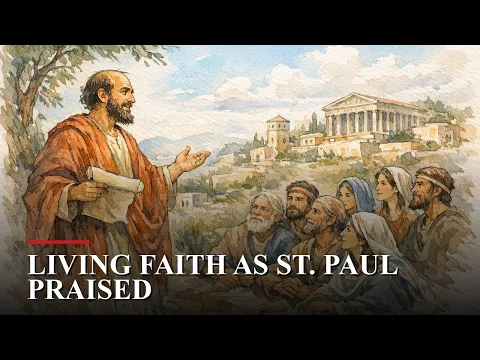
Living Faith as St. Paul Praised
Summary of Headings
- St. Paul's Praise for Thessalonians
- Faith as a Divine Gift
- Living and Growing Our Faith
- Faith as a Missionary Tool
- Practical Ways to Live Faith
St. Paul's Praise for Thessalonians
The epistle for today gives us a very beautiful image of St. Paul actually praising his flock in Thessalonia. Normally when he writes to them, he's yelling at them about something or encouraging them in some way, but here he's outright praising them for their faith. So it's important, it's encouraging to us that even St. Paul could admire somebody else's faith, and the faith of his congregation. But it's also important for us to look into why he was so impressed with their faith above the others. Not the Corinthians, not the Colossians, not the Romans, but the Thessalonians.
What was different about them?
Faith as a Divine Gift
And he explains it. It's about their faith. They were not just receiving the word of God in word. They didn't just receive it in word, but they also received it in power and in the Holy Ghost. And that is the key for us. When we receive the faith, we forget a couple of different points. The first one is that it's a grace. We don't earn the faith. We don't win it. It is a grace from God. It is given to us in the generosity and love of God. So therefore, we need to respond to it as such. When we receive a gift, any sort of a gift, we always express our love for God.
our thanks. And we always use that gift. When we receive a gift, it's important that we always train our children and we always practice this ourselves, that we thank whoever gave it to us, whatever the gift may be. And we always try to use it out of gratitude for the person who gave it to us, thanking them for their generosity, thanking them for their thoughtfulness, and also just trying to understand the charity that went behind it. Then it's important also that we respond this way to the faith. We should respond gratefully for the fact
Living and Growing Our Faith
that we have faith. But more than that, it's a precious gift, which means we have to take care of it. It's something that is fragile. It's something that is delicate. So we must work to try to strengthen it and to make it better, to purify it, because we're imperfect, and so our use of it will be imperfect. So we need to purify it in our actions, in our prayers. We need to strengthen it with knowledge and with prayer. We need to ask God to protect our faith, and we need to ask God to let our faith grow. But more than just being grateful for it, part of it is we must put it to good use.
Our Lord talks about in a different parable the man with talents, the different talents that are given to the three men. To one man he gave five talents, to another two. And another one, and the one with five made five more off of investments. One with two made two more off of investments. The one with one buried it and hid it away. And the one who when our Lord came back, he saw that. He took the one from the one who received one and gave it to the one who had ten. Because he didn't give us our faith just to have. And just that when we come back and we are judged by God, that we have exactly the same faith that we had as when we were young. And that's why we have the same faith that we had as when we were young.
And we received it. He gave it to us. He gave our faith to us so that we can learn about him. And we can learn to know him and love him and serve him. That is the purpose why we have faith. To know him better so that we can love him and so that we can serve him perfectly. That is why we have it. So now we have to live our faith. That's what St. Paul praises about the Thessalonians. That they lived their faith. So much so that in other places, in Macedonia, in Achaia, the Thessalonians were used as examples to the converts about how they were supposed to live their faith.
So those of us who have the grace of receiving faith, we must live our faith to the point that others can look to our example and try to follow it. That's not why we should try to live our faith. Of course not. But that is an encouragement. Because there are many people who don't know how to live their faith. And there are many people who don't have faith. And all they need is someone to show them what faith really looks like. What faith should look like. The joy that comes with knowing that we belong to God. The joy of knowing that God is always present with us.
The true joy that the world cannot take away regardless of everything else by the mere fact that God belongs to us and that we belong to him. That we live with him constantly and perpetually. That we are called children of God. That we are adopted children. All of these things should bring us tremendous joy and peace of soul. So much so that the world should look upon us as being different from them because we are. And that is not why, again, why we should practice our faith. But it is an added benefit because this is how we become missionaries. This is how we help God save souls. We become his instruments in the salvation of souls.
Faith as a Missionary Tool
But we must live our faith in another way. And that is by preaching it. St. Paul talks about the fact that he's actually gone to other places where he hasn't had to say a word. Because the renown of the Thessalonians' faith has spread to places that he hasn't even started preaching the gospel. The renown of his teaching to them and how they took it has already spread to other places. And the Thessalonians themselves have already been preaching the word. They were so filled with the Holy Ghost and what they had received that they actually went out to other places and preached the faith themselves. Becoming actual real missionaries. Telling the story of how St. Paul came to them and taught them the faith and converted them.
This is the template of how we must live our faith. Our faith must consume us. One of the main errors of how we practice our faith, as I mentioned before, it never grows. So now we must make it grow. We don't protect it so it dies away. We must protect it and we must make it thrive, like the mustard seed. It isn't enough that we just have the seed. We must plant it, cultivate it, work it, so that it becomes this glorious tree that it becomes later on. We must try to learn how to live our faith. Our faith should become the guiding principle for every aspect of our lives. When we wake up, it must become an act of faith.
Faith. Archbishop Sheen famously said that there are two types of people who wake up in the morning. The ones who wake up and say, good morning, God. The other one who wakes up and says, good God, it's morning. Which one's the act of faith? Well, it doesn't take that hard, it doesn't take that much to figure it out. The one who wakes up recognizing the fact that we wake up, the fact that we still have life, the fact that we are with God is something truly extraordinary. It's a gift from Him, so we respond to Him. That's why at that very moment of faith, we wake up and we say, our first action should be a morning offering, where we unite our entire day with all of its trials and sufferings, with all of its works and labors, and every word and thought and deed that we do that day. We unite it to the Holy Mass, and we sacrifice each and every part of it.
And then we try to renew that sacrifice throughout the day. We try to live in the presence of God. We try to live our faith, absolutely. Our faith should influence how and what we eat. Our faith should influence how we drive. It should influence how we interact with people. It should influence how we work, how we study, how we prepare for a test, how we listen to our parents, how we attend Mass. Faith is not relegated and compartmentalized into a very specific category of our life, where it's when we come to Mass on Sunday, and it's when we say the Holy Mass. It's when we say the Holy Mass on Sunday, and it's when we say the Holy Mass on Sunday, or whatever. Faith is for every instant of our day. We should breathe the faith. We should bleed the faith. The faith needs to become the essence of who and what we are, because it is the very life of our Lord Jesus Christ, and that is the life that we are supposed
to live. We don't have to preach our Lord Jesus Christ. We have to live our Lord Jesus Christ so everyone can see him through us, so everyone can learn to love him through us. We must learn with all of our heart to live the faith. It is the single most important thing in our lives. It teaches us charity. It teaches us hope. It teaches us prudence, peace, and love. It teaches us the power of God. It teaches us the power of God. It teaches us the peace of soul, generosity of heart, kindness to others. It teaches us how to really be a true disciple of Christ, someone who loves God above all things and lives for God and for him alone, someone who's willing to sacrifice their very life for God, like a martyr, someone who's willing to dedicate their life to God, like a confessor, like a pastor, like a pastor, like a pastor, like a pastor, like a pastor, like a pastor, like a pastor, like a pastor, like a pastor, like a pastor, like a pastor,
someone who's willing to sacrifice their life in every possible way, but someone who is also willing to live that life so that through him, through us, the world can see, the world can see Christ and find hope again. This world so badly needs our Lord Jesus Christ. But in order for us to be able to reveal him to everyone else, he must possess us. He must fill us. Like that little bit of leaven that our Lord talks about in the gospel today. A woman puts just a little, a pinch of leaven into a bunch of meal. By moving it around, every bit of that meal is leavened. Put a little bit of yeast and flour, you mix it up, all of it is leavened now. That little bit of faith is supposed to influence every part of our being.
Practical Ways to Live Faith
We're supposed to keep making it live within us in actions, small, tiny actions every day. How do we do that on a practical level? How do we live our faith on a practical level? Well, there's a couple of different things that we can do. Very specifically, maybe we should think before we make the sign of the cross. How often do we just make the sign of the cross and don't even think about what we're doing? It's a declaration of faith. We're professing our belief in the incarnation, the crucifixion of our Lord Jesus Christ, and that he is our salvation. We are declaring ourselves as Catholics, and we are professing our faith in the blessed Trinity, all with that simple action and that simple little prayer. How often have we thought of that when we make the sign of the cross?
When we bless our meals before food, sorry, bless our food before meals, excuse me. It's the same thing. How often do we do that little action or don't do it, before eating, without even thinking about what we're doing? We are consecrating the action of eating, of sustaining our body so that we can serve God better. We are consecrating it to the service of God and making it something holy. How often do we think about when we put on our miraculous medal or our scapular in the morning? How often do we think about what that means, or we touch or feel our scapular, what it means to truly be consecrated to the Blessed Virgin Mary, to live our life in her service?
That's her paladin wearing her uniform. How often do we think about these things? Now it's time to start thinking about those things. That's one way of starting to live the faith of our Lord Jesus Christ. Another way is to practice the presence of God. First, like I said, the morning offering, and then throughout the day, we remind ourselves somehow. We have something that is there to remind us. Could be a little crucifix. It could be an image. It could be a little cross. It could be a little cross. It could be a little cross. It could be just the alarm we put on our cell phone to remind us that we are supposed to remember the fact that we have consecrated our day to God and that we live in his presence, that he is truly present.
Every person we run into, our Lord Jesus Christ is there present in that interaction. Every action that we perform, he is there with us. We have to choose at that point to voluntarily live in that presence and to offer what we are doing as an action with him, by him, and in him. That is the plan. That is how we are supposed to live in his presence. That's another way. Another way that's very important is a spirit of contemplation. We must meditate upon the reality of our faith, which is the permanence and the existence of God. We must meditate upon the essence of what our faith is and how it is supposed to influence and guide our very life. We must meditate upon the faith to understand and contemplate how we are supposed to live in his presence. That's another way.
We must meditate upon the reality of our faith, which is the permanence and the existence of God. Our actions and every part of our being must now represent God because we are filled with him. And we must make the determination through that contemplation that he is the only thing that matters and that we live for him, by him, and with him. These are the ways that we can start to practice this presence of God and how to practice living our faith, not just having it, not just talking about it, but really living it to make it real. To make our faith fruitful, like the mustard seed.
To make our faith permeate every part of our life, like that pinch of leaven. To transform our life from simply human and mundane, from this world, to something truly glorious and divine, and therefore we can become saints eternally happy with him in heaven, hopefully bringing many others with us through our example. In the name of the Father, and the Son, and the Holy Ghost. Amen.
Summary
St. Paul praises the Thessalonians for their faith, which was not only received in word but also in power and the Holy Ghost. This serves as a model for us to live our faith actively. Faith is a divine gift that requires nurturing and growth through prayer, knowledge, and action. We are encouraged to live our faith fully, allowing it to influence every aspect of our lives. By living our faith, we become missionaries, inspiring others through our actions and example. This homily calls us to be instruments of God's grace in the world.